Agentic AI Proof of Concept
Giving an emerging idea a human point of view.
Agentic AI raises useful questions about how people and intelligent systems might work together. For this proof of concept, I led the experience design work that made those questions tangible: user flows, iterative prototypes, and scenario simulations people could explore and respond to.
- My role
- Senior UX Researcher & Designer
- Focus
- Research, flows, prototypes, simulations
- Context
- Healthcare AI · Research and prototyping
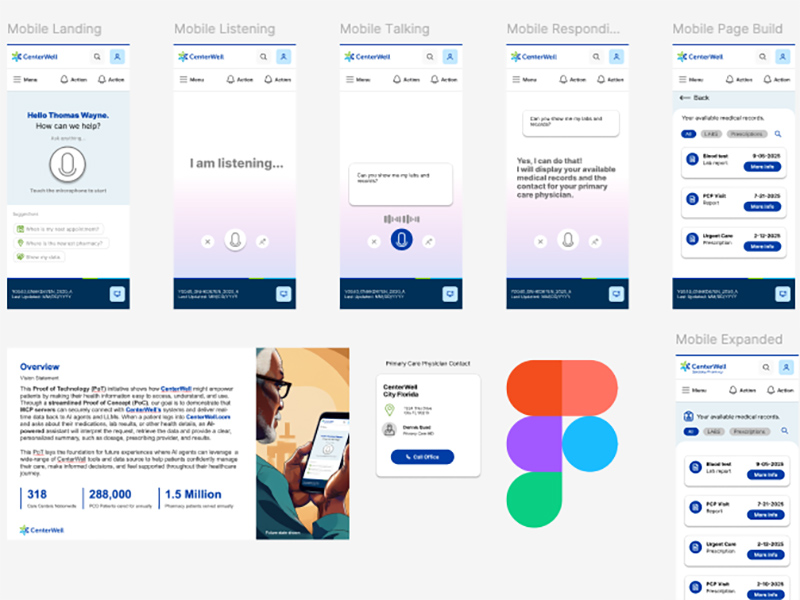
Mobile interaction concept screens from the proof of concept.
The challenge
The work brought together CenterWell clinicians, operations staff, and a technology partner to explore an agentic AI experience in healthcare. The proof of concept created a way to examine interaction models and workflow fit while the idea was taking shape.
A promising technical concept needs an understandable experience before a team can assess its usefulness. The design challenge was to clarify how interactions might work, where the experience could fit into existing workflows, and what would help people understand and trust it.
My contribution
Senior UX Researcher & Designer, leading end-to-end UX for the proof of concept.
01. Learn from the people doing the work
Stakeholder interviews brought clinicians’ and operations staff’s perspectives into the exploration. I used those conversations to connect the technical idea to the people who would need to make sense of the proposed experience.
02. Turn possibilities into something testable
I created user flows, mockups, iterative prototypes, and agentic AI scenario simulations. These artifacts gave the team concrete scenarios to examine, including interaction patterns, workflow integration, and points where trust would need attention.
03. Use feedback to clarify the experience
Usability testing and stakeholder conversations informed the evolving design. I also developed stakeholder narratives to explain the proposed experience and help collaborators discuss its purpose, interactions, and place in the workflow.
What the work made possible
The work produced flows, prototypes, and scenario simulations that made the concept easier to evaluate. It helped align stakeholders around a proposed experience and the questions it raised about workflow fit and trust. This case covers that proof-of-concept work.
What stays with me
In my everyday practice, I use AI to explore concepts and make changes quickly so large teams can understand the work together. As a lead designer, I carry responsibility for clear communication as well as the design itself.